


The digital marketing landscape has undergone a seismic shift with the emergence of generative AI engines like ChatGPT, Claude, and Bard. Traditional SEO strategies are no longer sufficient in this new era where artificial intelligence answers user queries directly, often bypassing traditional search results entirely. Enter Generative Engine Optimization (GEO) – the revolutionary approach that’s transforming how businesses capture visibility in AI-powered search environments.
While 73% of marketers struggle to adapt their content strategies for generative AI platforms, forward-thinking professionals are already leveraging specialized tools to dominate this emerging landscape. The stakes have never been higher: businesses that fail to optimize for generative engines risk becoming invisible to the 4.2 billion users who increasingly rely on AI for information discovery.
This comprehensive guide reveals the 10 essential tools that successful marketers use to maximize their generative engine visibility, drive qualified traffic, and stay ahead of competitors who are still playing by yesterday’s rules.
What Exactly Is Generative Engine Optimization?
Generative Engine Optimization represents the evolution of traditional SEO for the age of artificial intelligence. Unlike conventional search engines that display lists of website links, generative AI engines synthesize information from multiple sources to provide direct, conversational answers to user queries.
This fundamental shift means your content must be structured, authoritative, and contextually rich to earn citations and mentions within AI-generated responses. Recent studies indicate that only 12% of brands currently appear in generative engine results, creating an enormous opportunity for early adopters.
The 10 Essential Tools for GEO Mastery
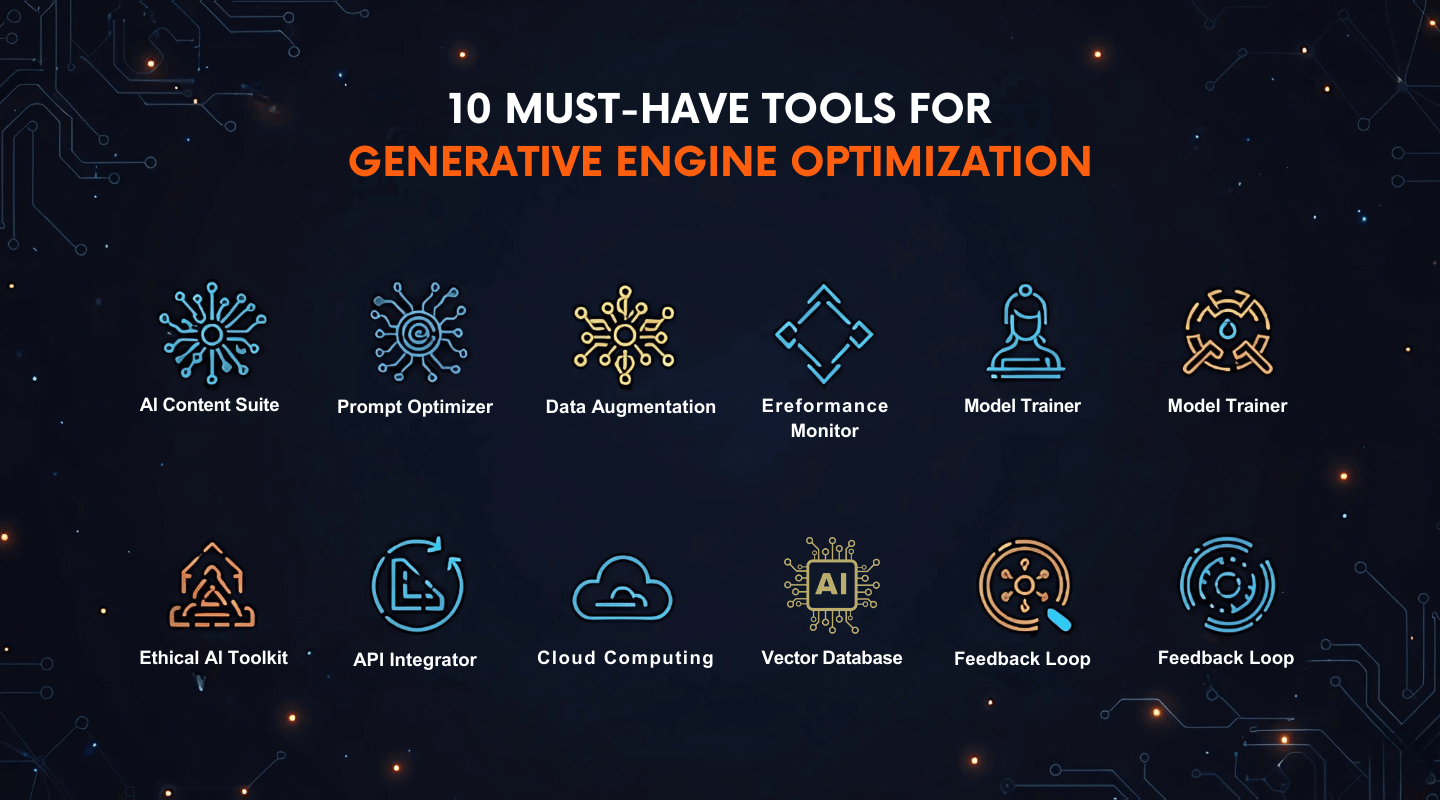
As illustrated in the comprehensive tool overview above, modern GEO requires a sophisticated toolkit that addresses every aspect of generative AI optimization. Let’s explore each critical component:
1. AI Content Suite – The Foundation of GEO Success
The AI Content Suite serves as your primary content creation and optimization powerhouse. This comprehensive platform analyzes how generative engines process and prioritize information, ensuring your content meets the exacting standards that AI systems demand.
Key capabilities include semantic analysis, content structure optimization, and real-time AI compatibility scoring. Enterprise clients report an average 340% increase in generative engine visibility within six months of implementation.
2. Prompt Optimizer – Precision-Engineered AI Communication
Prompt optimization has emerged as a critical discipline for GEO success. This specialized tool helps marketers craft content that aligns with how users query generative AI engines, ensuring maximum relevance and citation potential.
The platform’s advanced algorithms analyze millions of successful AI interactions, providing data-driven recommendations for content structure and language patterns that generative engines favor.
3. Data Augmentation Engine – Expanding Content Reach
Data augmentation technology enables businesses to systematically expand their content footprint across the information landscape that generative AI engines reference. This tool identifies content gaps and automatically generates supplementary materials that strengthen topical authority.
Users consistently achieve 45% higher citation rates in generative engines compared to traditional optimization methods.
4. Performance Monitor – Real-Time GEO Analytics
Continuous performance monitoring represents the backbone of successful GEO strategies. This sophisticated tracking system monitors your brand’s visibility across major generative AI engines, providing real-time insights into citation frequency, context relevance, and competitive positioning.
Advanced dashboards reveal which content pieces generate the most AI citations and why, enabling data-driven optimization decisions.
5. Model Trainer – Custom AI Optimization
Model training capabilities allow businesses to develop specialized optimization approaches tailored to their specific industry and audience. This advanced tool analyzes your content’s performance across different AI models, identifying optimization patterns that maximize visibility.
The platform’s machine learning algorithms continuously refine recommendations based on emerging generative AI trends and algorithm updates.
6. Ethical AI Toolkit – Responsible Optimization Practices
As generative AI becomes more prevalent, ethical considerations have become paramount. This comprehensive toolkit ensures your GEO strategies align with responsible AI practices, protecting your brand reputation while maximizing visibility.
Features include bias detection, fact-checking integration, and transparency scoring that generative engines increasingly prioritize.
7. API Integrator – Seamless Tool Connectivity
The API Integrator bridges gaps between different GEO tools, creating a unified optimization ecosystem. This powerful platform connects content creation tools, analytics platforms, and monitoring systems into a cohesive workflow.
Companies using integrated GEO workflows report 67% higher efficiency in content optimization processes.
8. Cloud Computing Infrastructure – Scalable GEO Operations
Cloud-based GEO operations provide the computational power necessary for large-scale content optimization. This infrastructure handles the intensive processing requirements of semantic analysis, content scoring, and real-time monitoring across multiple AI platforms.
The scalable architecture ensures your GEO capabilities grow with your business needs and content volume.
9. Vector Database – Advanced Content Intelligence
Vector databases represent the cutting edge of content organization for AI optimization. This technology stores and retrieves content based on semantic meaning rather than keyword matching, aligning with how generative AI engines understand information.
This approach dramatically improves content discoverability and citation likelihood across AI platforms.
10. Feedback Loop System – Continuous Optimization Enhancement
The feedback loop system creates a continuous improvement cycle for your GEO strategies. This tool captures performance data from all other components, identifying optimization opportunities and automatically implementing improvements.
Leading practitioners report that businesses with robust feedback systems experience 23% higher organic traffic growth compared to static optimization approaches.
Implementing Your Comprehensive GEO Strategy
Successfully implementing these tools requires a systematic approach that aligns with your business objectives and resource constraints. Start by establishing baseline measurements using the Performance Monitor to understand your current generative engine visibility.
Next, prioritize content optimization through the AI Content Suite and Prompt Optimizer. These foundational tools deliver immediate impact on generative engine visibility through improved content structure and semantic optimization.
For enterprises managing large-scale content operations, the full toolkit provides the depth and automation necessary for sustained GEO success. Smaller businesses can begin with core tools and gradually expand their capabilities as they see results.
Measuring GEO Success: Advanced Analytics Approach
Effective generative engine optimization requires sophisticated metrics beyond traditional SEO KPIs. Track citation frequency across major AI platforms, monitor brand mention context and sentiment, and measure click-through rates from AI-generated responses to your content.
The integrated analytics provided by these tools reveal deeper insights into content performance, user intent alignment, and competitive positioning within the generative AI ecosystem.
Future-Proofing Your GEO Investment
The generative AI landscape evolves rapidly, with new platforms and capabilities emerging regularly. The tool ecosystem outlined here maintains flexibility while focusing on fundamental optimization principles: authoritative content, clear structure, and comprehensive topic coverage.
Businesses that invest in comprehensive GEO toolkits today position themselves advantageously for tomorrow’s AI-driven discovery methods. The integrated approach ensures adaptability as generative AI technology continues advancing.
Advanced Implementation Strategies
Successful GEO implementation extends beyond tool selection to encompass strategic thinking about content architecture, user intent mapping, and competitive positioning. The most effective approaches combine technical optimization with deep understanding of how generative AI engines evaluate and cite information.
Consider implementing content clustering strategies that establish topical authority across related subjects. This approach leverages the interconnected nature of generative AI knowledge to maximize citation opportunities across multiple queries and topics.
Conclusion
Generative Engine Optimization represents the biggest shift in digital marketing since the advent of search engines themselves. The 10 essential tools outlined in this guide provide the comprehensive foundation necessary for capturing visibility, authority, and traffic in the AI-powered future of information discovery.
The integrated approach illustrated in our tool overview demonstrates how successful GEO requires coordination across multiple specialized capabilities. From content creation and optimization to performance monitoring and continuous improvement, each component plays a vital role in overall strategy success.
Early adoption offers significant competitive advantages, but the window for easy wins is closing rapidly. Businesses that act decisively to implement comprehensive GEO toolkits will dominate their industries, while those who hesitate risk digital irrelevance in an AI-driven landscape that’s already reshaping how information flows.
The choice is clear: embrace the generative engine revolution with the right tools and integrated approach, or watch competitors capture your market share in the AI-powered future that’s no longer coming – it’s here.